
|
Social Exclusion of Tea Plantation Workers: A Study on Moulvibazar District, Bangladesh
Goutam Dey1.*,Mahabuba Uddin2
1Department of International Relations, Gopalganj Science and Technology University, Gopalganj-8100, Bangladesh 2Assistant Professor, Department of International Relations, Gopalganj Science and Technology University, Gopalganj-8100, Bangladesh |
|
Keywords |
|
Abstract |
|
Social exclusion, Socio-economic condition, Tea workers |
|
This paper presents the social exclusion and socio-economic condition of tea plantation workers in the context of Moulvibazar district in Bangladesh. Tea plantation workers are one of the backward, marginalized, and vulnerable peoples who are isolated from mainstream community for many years. Qualitative data collection and purposive sampling method was taken. This paper deals with literacy, health, sanitation, education, and other socio-economic conditions; attempts to understand how the poor rate and situation of these issues lead to exclusion of tea plantation workers from different aspects of society. Finally, it suggests some recommendations and measures for scaling up their standard of education, health, social acceptance, and overall life. |
Introduction
Tea is the second largest cash crops after jute in Bangladesh. Bangladesh is the eighth tea producing country in the world (Chowdhury and Haldar, 2023). A British citizen, Mr. Robert Bruce might be considered as father of tea plantation in this subcontinent from Assam in 1834 (Hossain, 2015). The first commercial-scale tea garden in Bangladesh, Malnichara, was established in 1854. Today there are 168 tea gardens in Bangladesh located in eight districts. Among 168 tea gardens, 90 gardens are situated in Moulvibazar, known as tea capital of Bangladesh, which are account for 55 percent of the production (Haldar and Sarker, 2023). According to some estimates, there are about 7,00,000 tea workers in the country (Ahsan and Chowdhury, 2021). The tea garden workers of Bangladesh live a poor life because of their low income receiving 170 BDT for a day’s work from morning to evening, which is less than US$1.5 and of course below the poverty line defined by the World Bank. The labor working in various tea gardens all over the 8 districts have been living a life of undefined penury. There is a contention that the women, explored educational condition of tea workers and said that only 8% peoples of their survey went to colleges, which indicates low education level among tea workers. Majumder and Roy (2012) focused on tea worker's health, safety, discrimination, and gender inequality. They studied that more women were engaged in field work as plucker than their male counterpart. Men were doing usually factory work and as organizational stuff. In relation to that, we know that there is Tea Act 2016 and Bangladesh Labor Act 2016 determines the safety of tea garden workers. In both laws, there are provisions for minimum wage standard and providing equal access to all national amenities. To establish the rules there are two institutions working on it, one is The Bangladesh Tea Association and the other is the labor Union of tea garden workers. With a negotiation with the government, they proposed minimum wages should be 300 taka, whether the government agreed to 170 taka. This dispute is still ongoing, and workers demand to follow ILO standards (Nawsin, 2022). In a recent report of Citizens’ Platform for SDGs, Bangladesh, they showed that tea pickers are suffering from unequal social treatment where they lack education facilities and suffer from sanitation and health problems. They also found that these people do not own any private property, and locals barely accept them in a social program. So, this means that, because of the unfair treatment, the tea plantation workers are socially excluded, and they are considered out of the mainstream population.
According to a report of Solidarity Center in 2023, child labor is common here and women health safety or pregnancy crisis are also common. There are no medical facilities available for them. Sometimes, they do not get any lunch break. The International Labor Organization (ILO) published a report on 2024 where they mentioned that the government is less interested in providing proper care to tea plantation workers and policy measures should be implemented without any delay to enhance this export-led economic sector.
The above-mentioned literatures have briefly discussed socio-economic condition of tea plantation workers. Tea workers live the life of excluded and marginalized for years due to ignorance of government, garden authority, and mainstream community. Therefore, this study has made an attempt to explore the status of social exclusion of tea plantation workers in Moulvibazar district.
Methodology
With the objectives of an in-depth exploration of social exclusion status and socio-economic condition of tea plantation workers, the research project used both primary and secondary sources of data. The Primary data were collected through face-to-face interview. Firstly, 240 participants were selected where 144 respondents were male and 96 were female. They answered 26 questions. The age of those participants is 19 to 57.
The secondary data were being collected through the study and analysis of data that has already been published for use like books, articles, journal papers, reports, documentaries, newspapers, internet, relevant websites, and garden authorities.
Mixed approach both qualitative and quantitative is used and followed to conduct the study. The research area of the study is two tea gardens of Moulvibazar district. The study is conducted in Dhamai Tea Estate and Sunarupa Tea Estate. List of workers is unavailable therefore random sampling procedure has been followed to select sample for the study. Data were collected through interview. There were 240 respondents who participated in survey. Semi structured questionnaire was used as survey tool which were prepared keeping the objectives of the study in mind. Qualitative data have also been collected from a focus group discussion with the tea plantation workers. All the responses have been collected in Bangla and translated into English.
The collected data were processed and formulated, avoiding irrelevant and unnecessary information; were analyzed according to the objectives of the study, using simple statistical method. This Primary data was collected from 15 January 2024 to 3 May 2024 in Moulvibazar District. Between the timeframe I have collected necessary data from the tea plantation workers of above mentioned gardens.
Results and Discussions
Socio-demographic profile
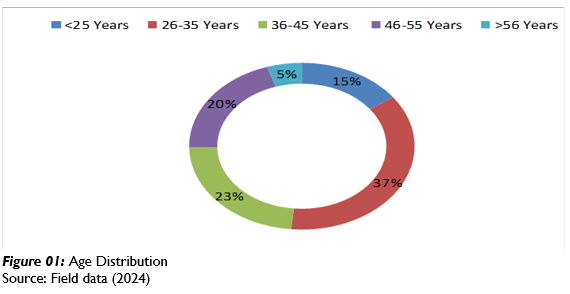
The study data shows that among the respondents 60% are males and around 40% are females. Study found that 78.33% of the workers have permanent position, while 21.67% of the workers is employed as temporary or casual workers. Both younger and older workers are employed in the tea gardens but tea industry is dominated by middle-aged workers. Approximately 36.67% of the workers are in the age group of 26-35 years. The second highest age number of 23.33% of the respondents fall on the age group 36-45, and 20% are between the age group of 46-55 years, while 15% of the respondents are in the age group of <25 years and the lowest number (5%) of respondents' age is more than 56 years.
Both married and unmarried people are employed as workers in the tea garden. The field data indicates that about 85% of the respondents are married and rest of them are unmarried. On the basis of household size tea garden workers were classified under three categories: small, medium, and large. 66.67% of the respondents were medium (4-6) size family, 15% small (up to 3) size, and 18.33% large (7-9) size family.
Ethnic identity and language:
Tea plantation workers identified themselves as a distinct group (Ahmed and Hossain, 2016). The British companies brought workers from Assam, Orissa, West Bengal, Bihar, Madras, Andhra Pradesh, Meghalaya, Madhya Pradesh, Uttar Pradesh, and other different states of India; they are still identified with those ethnic identities. According to the BRAC census, only 5 ethnic minority groups live in the tea gardens, among 69 minority groups in Bangladesh, they are Bangli, Bhujpuri/Deshwali, Oriya, Saddri, and Telegu (Chandra and Roy, 2012). Among all workers, we have found most of the tea garden workers belong to Hindu community in the two gardens. Some castes among the workers of Hindu religion found in the two tea gardens include Robidas, Bauri, Bahadur, Nayek, Rikmon, Shobdokar, Naidu, Rai, Munda, Kundo, Barai, Shill, Pashi, Goala, Bunargee, Nunia, Kairi, Mal, etc. Though they have distinct culture and norms, it is rarely practiced outside the tea garden and they feel uncomfortable to disclose their identity fearing discrimination and loosing employment.
Most of the workers are identified with speaking a modified and combined language of Bangla, Deswaly/Deshali (mixture of Bangla and Oriya), Hindi, and Assomia commonly known as the language of tea garden. Few speak in Assomia, Munda, Orang, Telugu, Santali, Bhosepuree and Khasi. Tea community leaders observed that due to lack of practice, their languages are disappearing (Ahmmed and Hossain, 2016).
Different aspects of social exclusion and socio-economic condition:
Literacy condition:
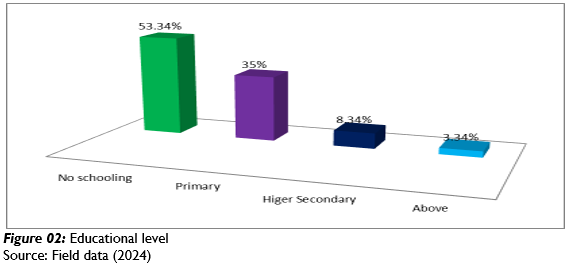
Education is an important ladder for transformation of a community or society for betterment is at the root of the social exclusion of the tea garden workers (Chandra and Roy, 2012). Educational level of the respondents categorized into four groups (illiterate, primary, higher secondary and higher education) to easily interpret educational information. The level of education of the tea workers presents the distressful picture that shows around 53.34% of the respondents are illiterate whereas 35% of them passed primary education, 8.34% workers completed higher secondary. The study shows that around 3.34% of respondents are enrolled as undergraduate students at university. Approximately 86.67% workers express dissatisfaction about the scope of child education in their gardens. But some peoples also shared that after completing higher education 4 to 5 peoples from their community are doing government and corporate job outside the garden now which means situation regarding the education is changing gradually.
They had no chance of education, they said “we are here for working and not for education, the authority are against to educate us”. As a result they remain illiterate or have only primary education. They also said “now there is no restriction to educate their children and many of their children are going to university level" (Ahmad, Yasin, Rowshon & Rafiqul, 2015).
After interviewing them, five reasons came forward why they were not getting proper education.
These are
Monthly income:
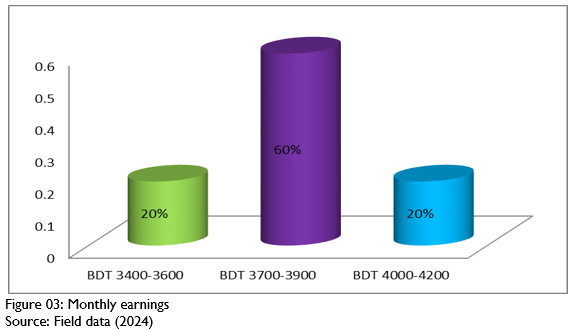
The tea plantation workers in Bangladesh are much lower paid compared to other tea producing countries like India, Srilanka, China, Indonesia and Kenya (Hossain, 2021). The tea workers work hard but they get low salary for which they are unable to manage decent living standard. They get their salary weekly based on daily performance. They get BDT 170 as per the new order intervening by the prime minister during protest to increase their wages. Monthly wages of respondents are categorized into three groups (BDT 3400-3600, BDT 3700-3900 and BDT 4000-4200) to easily interpret the wages information. Analyzed data discloses that 20% of total respondents are getting BDT 3400-3600 per month as wage. The highest numbers of respondent (60%) are getting BDT 3700-3900. And 20% of the workers belong to earning group of BDT 4000-4200 (casual workers and work outside the garden) Permanent workers get the above mentioned money after deduction of a particular amount (total salary/7.5) to provident fund. They get two festival bonus in a year which is 52 times of their daily wages. They get BDT 5240 at the time of Durga Puja and BDT 3600 at the time of Fagua festival (holi). All of the workers said that they get their wages at the weekend in regular basis but sometimes they face delay or irregularities in getting bonus or allowance.
They usually must pick around 25 kgs of tea leaves per day. After introducing digital weight machine to weigh plucked leaves they do not have any complaint as there were allegations of corruption against authority in weighing using analogue weight system. They often work beyond the legally permissible limit of eight hours for six days a week to meet the target of 25 kgs. Although they are paid extra for plucking extra leaves, they are not paid any wages for working extra hours. This violates the Labour Act which allows extra allowance for working beyond the permissible working hours (Ahsan and Chowdhury, 2021).
One of the respondents expressed that "we are very needy people and our earning is too little to meet the basic demands of our family."
Savings:
Tea Garden worker are living under extreme poverty line. All respondents said that their salary is too little to arrange general livelihood. For them savings is an unachievable dream. Approximately 88.33% of the respondents have claimed that they are unable to make any savings. Only 11.67% respondents have future savings scope. Most of them are casual workers and they work outside the garden so that they get better wages. The study explores that only 16.67% respondents have savings account with bank and they are educated enough (passed higher secondary or enrolled in university). But they have a little money as diposit in their accounts. For scarcity of savings and opportunities they cannot be involved in income generating activities or cannot develop their entrepreneurial skill. Rather they involve in traditional work and survive hardly.
Access to credit:
All respondents of the research area have said that they have no access to formal credit system from bank and garden authority. They could not borrow loan from a commercial bank because of the lack of legal property and documents as commercial banks do not offer any loan without collateral or mortgage. Approximately 35% of respondents in the tea worker communities took microcredit from different NGOs and cooperatives.
The receivers of credit used the money for buying cows, maintaining expenditure of family, paying another debt, buying furniture for the households, maintaining marriage expenditure, providing dowry, repairing house, and for small business.
Housing Condition and sanitation facility:
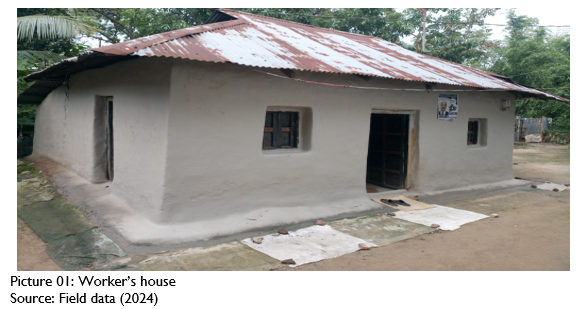
As a special consideration for tea workers shelter, 'Bangladesh Labour Act 2006' made an order to employers to ensure that all workers and his family residing in the tea plantation are provided housing facilities (Ahmed, 2016). Permanent labourers get a house as fringe benefit from tea garden authority. But if both husband and wife work permanently in the same garden they get only one house. Their living condition in that houses lacking proper bedding and ventilation is unhygienic, miserable, unhealthy, and dissatisfactory. The average size of the house is 12 feet by 8 feet. Most of the houses are made of using tin, bamboo, and mud was found in the study area. About 81.67% of the houses were built with mud while 18.33% houses were tin shade. In these houses more people are living than their accommodation capacity. There are no separate kitchen and have a little privacy. During rainy season, situation become more miserable because rain water gets into the room through broken wall and roof. Sometimes they are seen living with their livestock cattle (cows, goats, and poultry) in the same room by building a partition, which creates serious health issues.
According to the Labor Rules the companies were supposed to provide latrines for the tea workers (Hossain, 2021). According to BBS (2019), 67% families do not have minimum sanitation facility in the tea gardens of Sylhet region. It is a matter of grave concern that the sanitation facilities is very poor in research area. In the field study we found that 85% of respondents have direct pit toilet (without water seals) in their houses. On the other hand sanitary latrines are available to only 15% of respondents. Wastage from children and old patients who are unable to go toilet disposed to water bodies like ponds, canal, or nearby jungle. Most of the respondents want to be ensured of having scientific sanitation facilities. Adequate hand washing practice is rare in tea garden area. As per HFNSP 2011 the proper hand washing practice is only 4% in tea garden area (Hossain, 2021).
About 85% of the workers interviewed for the research expressed dissatisfaction with the size, quality, design, other facilities like sanitation and drinking water, and overall housing accommodations provided to them, which they seek to improve.
Healthcare facility:
Respondents are categorized into three groups (good, moderate, bad) to easily interpret collected information. The figure reveales that no laborer is satisfied with the medical facilities. 90% of total respondents opined that medical facility is bad. Only 10% are agreed to some extent and said that facilities they have taken are moderate.
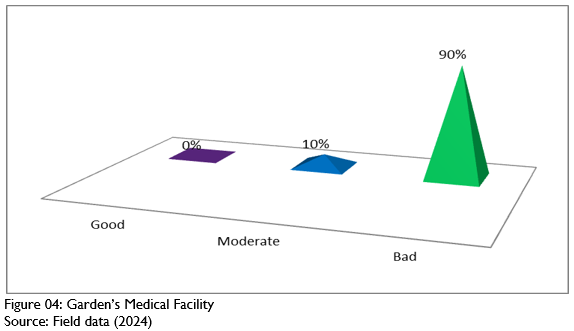
For the lack of sufficient medicine supplies, doctors, professional training, and other medical equipment, workers are very often deprived from essential healthcare services. In our field survey, I saw that paramedics run the centers that can provide only primary care for common diseases like cold, cough, gastric, diarrhoea, and so on. In the dispensary only some common medicines like paracetamol, omeprazol, domperidone, ciprofloxacin, diclofenac, and oral saline are available. According to Moulvibazar district civil surgeon, 631 out of 761 leprosy patient identified over last 4 years and 36% tuberculosis patients diagnosed per year belong to tea garden community. Along with other general diseases, some occupational diseases like; pains in back, muscle and other body part, respiratory and water borne diseases (caused for working constantly in cold, hot, and wet weather) are common among the tea workers. Medical services are available only once a week and there are no MBBS or female doctors although 40% of the workers are female. The study finds that 60% of the respondents go to nearest government upazila health complex for better treatment. On the other hand 30% respondents depend on local quack, kobiraj and medicine shopkeeper who do not have any license as medical practitioner. Only 10% respondents take treatment from garden dispensary when medical service become available once a week for them. Provision of various health programs like deworming, vaccination, and intake of vitamin A capsule is disappointing. There is no ambulance service provided by garden authority for emergency situation.
They neither get sick leave nor any medical allowance, bonus or extra money for treatment. In the event of an unexpected accident on duty, the worker is sent to hospital and expenses related to treatment are arranged by tea garden authority but most of the respondents alleged that expenses are not fully paid by the authority. In case of sickness, workers are replaced by their other family members to get wages and ration. Pregnant women are entitled with 3 months paid maternity leave but there is no provision of paternal leave.
This violates article 12(2) of the Convention on the Elimination of All Forms of Discrimination against Women, 1979 (CEDAW), which provides that State Parties shall ensure appropriate services for women relating to pregnancy, confinement and the postnatal period, granting necessary free services as well as adequate nutrition during pregnancy and lactation (Ahsan and Chowdhury, 2021)
Food security:
Bangladesh Bureau of Statistics made a survey in 2019 in the tea gardens of Sylhet region which revealed that 45% children are short, 27% children are lathy and 47.5% children are under weight due to malnutrition in tea gardens. As per our findings, because of poverty around 31.67% workers and their families take meal 2 times a day. On the other hand approximately 68.33% peoples take 3 times meal but it lacks enough protein and nutrition. A permanent worker gets only 3.4 kgs of wheat per week as ration from garden authority which is absolutely insufficient to meet their necessity of food.
Access to water and energy:
Previously traditional well was the main source of drinking water in tea gardens. Data of the present survey show that 85% respondents use water from tube well and 15% respondents from ring well for drinking, bathing, washing cloths, and household works etc. The gardens have electricity access inside it. Every household has to pay for the electricity use that has connection because garden authority does not provide any subsidy or fringe benefit on it. According to the study findings all respondents' household in the garden have electricity connection provided by the government agencies. Collected data reveals that the gardens have no gas connection but only the managerial staff use liquefied gas in their houses. Workers mentioned that they cannot afford the cost of liquefied gas due to poverty. All workers reported that they use firewood, sticks, and rest of the crops etc. as cooking fuel.
Child worker:
The Labour Act prohibits the employment of children in any occupation or establishment but allows the employment of an adolescent subject to restrictions (Ahsan and Chowdhury, 2021). According to national law, children under 18 are not allowed to work in the tea gardens but it is a regular case in the tea gardens (Ahmed and Hossain, 2016). Das and Islam (2006) found that Child labor is rampant in tea gardens. Our collected data reveals that 51.7% respondents have confessed the existence of child worker in gardens. Children do not engage as permanent/registered workers but as an assistant or substitute or complement of the other family members to generate some money and secure their residence and ration facility. Child labour reaches at its height during peak season. Since they are socio-economically poor and unable to maintain the familial cost by their income they try to increase their income by engaging their under aged children in tea plucking.
Gender inequality, Early marriage and Dowry system:
Approximately 31.67% from male respondents said that they have earning female members in their family but they face discrimination in workplace. Most of the female workers are engaged in field work like the job of plucking leaves rather than the job in factory or others. No baby care room or breastfeeding booth found in two gardens. Women have less access to organizational and representative posts.
Though a notable number of women are financially independent and working as tea plucker, dowry system is widely practiced in tea gardens of the research area. Approximately 66.7% respondents stated that they or their family members experienced dowry system during marriage and identified it as a burden for brides' family. Their parents take immature retirement to get the money of provident fund so that they can arrange and manage the cost of marriage of their daughter. It leads them to economic insecurity and children of these families were forced by circumstances to get involved in child labour to meet the damand of bread and butter for family.
BBS (2019) report reveals that 46% girls marry and 22% become pregnant before 18 years. We found early marriage so widespread as if it is their custom or tradition in the research area. Among 96 women participants of our survey, We found 68 women were under aged when they got married.
Political aspects of exclusion:
Though they are citizen and voter of Bangladesh, they are till today excluded from the mainstream community. Tea gardens look like a separate state into a state. Most of the tea plantation workers do not have any idea about political parties of Bangladesh (Hossain, 2021).

The study shows that about 53.4% of the respondents cast their vote in local or national election. Among them 60% workers object that they have faced influences by managerial authority, tilababu, sardar or head of the panchayet in making electoral decisions. As we were there for field survey till 5 days before upazila parishad election, some of respondents complained that the politicians tried to buy their vote during election campaign. It is also evident that none of them have participated in any election to be representatives of the people. They said that politics is not for us, it is for them who are financially affluent. They remain just as vote bank that can be used during different local and national elections by some local tricky politicians (Al-Amin, Hossain and Parveen, 2017).
Member of Cooperatives, NGOs and Organizations:
There is only one trade union for the tea workers for effective collective bargaining and protection of labour rights named Bangladesh Cha Shramik Union (BCSU). According to respondents it is existing only by name. Only 41.67% respondents are member of BCSU. Rest of them are illiterate and they have rare knowledge about the function of BCSU and they do not have membership. Most of the workers (46.67%) are dissatisfied with the activities of Cha Shramik Union complaining union leaders do not work for the welfare of the workers. Only 33.34% respondents expressed satisfaction on BCSU and 20% people did not comment on the issue and took neutral stance.
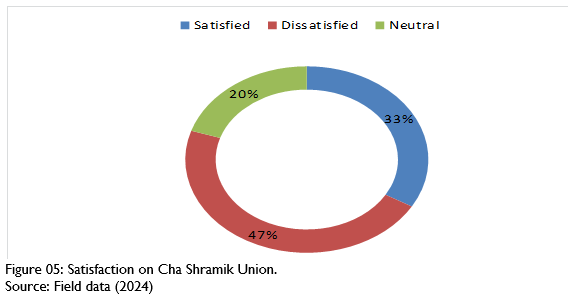
Our study found that only 35% respondents are member of various cooperatives and they have access to small savings and microcredit program. Some NGOs are engaged with microfinance, running water, sanitation and hygiene awareness program among the tea plantation workers. Tea garden authorities usually do not allow NGOs to run their programs because they fear that it may influence workers to protest inside the tea garden for their rights. Sometimes NGOs have to face difficulties to get approval from garden management to start activities in their garden.
Occupational safety and overall security:
In the tea plantation sector, workers’ safety and security issues are ignored widely. Tea plantation workers identified multiple risk factors including no shed closer to their workplace for taking shelter during rainfall, no break room for taking lunch, no baby care room, no toilet facilities, long working hours in harsh environment.
It appears from data analysis that all of the respondents complained that they are not given any safety kits. They spray insecticides and pesticides in bare hands, eyes, and feet which expose them to health hazards. Even they were not provided primary safety kits like hand gloves and masks. About 85% of respondents faces the threat of attack by animal (snake, monkey), various insects, and mosquitos during working in the garden.
The study findings express that about 66.67% respondents are concern about the security measures not taken for them. It is also observed that many of respondents take alcoholism as normal issue and opined that they drink home made alcohol. There are no police outpost and fire & rescue station even for temporary basis in the tea garden to ensure the security of a large number of people. It is a grave security concern and affiliated administration should pay attention on the issue.
Getting Respect, honor and proper services from government office:
A tea garden worker is treated as the least honoured and respected person in our society. Tea industry is labor intensive and they work so hard for the livelihood of life. They earned little money which can’t fulfill their demand properly. Moreover, every people needs dignity and honor. But they do not get proper honor and respect from the society also. Many respondents have a feeling that they are not equally treated with the mainstream people by the outsiders, and almost 45% respondents feel that they do not get respect and honor. The rest of the respondents do not have the feeling of any discrimination, exploitation, and exclusion from mainstream society as they used to this habit. Although 70% respondents opined that they do not feel any discrimination in government office and get proper service from the public officials.
Policy Recommendations
This paper offers the following suggestions and measures to improve the present condition of tea workers in the research area:
Conclusion
Tea is the most popular beverage, major export item, and sources of national income in Bangladesh. According to Bangladesh Tea Board, Bangladesh has produced record amount 10.29 crores of kgs tea in 2023 which is highest in last 184 years of history. But the lives behind the leaves of these producers are so difficult. Socio-economic condition of tea workers in the research area is not standard, satisfactory, and up to the mark. From the above discussion and explanation of collected data it can be concluded that they are still lagging behind. It is a labor intensive industry but the workers get minimum wages and fringe benefits compared to other countries; living below the poverty line defined by World Bank. They are excluded in economic, political, social, and cultural aspects of society. They are living a life of deprived and marginalized with illiteracy, inadequate health care system, poor housing and living conditions, and discrimination. They face plethora of difficulties just because of exclusion of their community from mainstream society. 'No one leave behind' mindset is required to ensure actual and sustainable development of Bangladesh. To bring the socially excluded community to light and way of progress, Government, garden authority, NGOs, mainstream community, workers, and other institutions all should work together.
References
Corresponding Author. E-mail: goutamdey494@gmail.com