
|
Women’s Electoral Participation in Local Government in Bangladesh: A Case Study
Dr. Md. Naim Akter Siddique*
Associate Professor, Department of Political Science, Jagannath University, Dhaka-1100. |
|
Keywords |
|
Abstract |
|
Electoral participation, Local government, Union Parishad, Rural women, Bangladesh |
|
Bangladesh is a patriarchal and traditional society where women constitute more than half of the total population. The total estimated population of Bangladesh is over 174 million, with females accounting for approximately 50.43% and males for 49.51%. The constitutional provisions of Bangladesh ensure equal rights and status for both men and women. This study explores women's electoral participation in rural areas of Bangladesh, with a focus on local elections. By combining qualitative and quantitative data analysis techniques, the study aims to analyze trends and dynamics of women's engagement in electoral processes and assess their position within the political landscape. Empirical data were collected from 181 women residing in rural areas of Bangladesh through a structured questionnaire. The analysis incorporates qualitative insights obtained through field observation and quantitative analysis using statistical tools. The study reveals that a significant number of women participate in local government elections, particularly at the Union Parishad (UP) level. However, women's involvement in electoral activities such as campaigning, meetings, political discussions, and election processions remains limited. The findings also indicate that young, educated, and socially aware women in rural areas exhibit higher levels of political engagement and electoral participation compared to their adult, uneducated counterparts. This study contributes to understanding women's electoral participation in Bangladesh and emphasizes the significance of education and social awareness in promoting increased political engagement among women. The findings have implications for policies and initiatives aimed at enhancing women's political empowerment and participation in local government in Bangladesh. |
Introduction
The act of voting holds significant importance within any democratic framework, serving as a crucial tool for citizen participation. Encouraging voter turnout is a common objective across political systems (Friedrich, 1986). Through voting, individuals can express their opinions, collaborate with others, have their needs addressed, and feel a sense of belonging to their community. While there are various forms of political participation such as meetings, rallies, campaigns, and personal contacts, voter turnout is influenced by multiple factors, including the electoral system, social groups, individual beliefs, and geographic location (Levinson & Pildes, 2006). The nature of elections also profoundly affects the level of electoral participation. Local elections hold equal importance to national ones, as effective local governance is crucial for fostering good governance and strengthening local institutions. The representation of local bodies based on democratic principles can contribute to the socioeconomic progress of a nation by utilizing its resources and population effectively (Islam, 2012).
The relationship between electoral participation and women's involvement in local-level government in Bangladesh is multifaceted and dynamic. Historically, Bangladesh has made significant strides in promoting gender equality and women's empowerment, particularly in politics. One of the notable initiatives in this regard was the implementation of quotas for women's representation in local government bodies. Bangladesh is a patriarchal society with men dominating societal strata in the country. Despite women constituting more than half of Bangladesh's total population, their status lags behind that of men in various social strata. In 2022, the share of the rural population in Bangladesh remained nearly unchanged at approximately 60.29%. While educated women work outside the home and act as breadwinners generating economic resources for families, most rural women in low- and middle-income groups work primarily in households. Their participation in elections and political representation remains limited, despite constitutional guarantees and legal provisions granting them equal rights (Dorf & Sabel, 1998). Political empowerment is indispensable for women to attain and sustain equitable social and economic standing (Kumar, 2013).
The Local Government (Union Parishad) Ordinance of 1983 resulted in a significant increase in women's participation in local politics through the introduction of reserved seats for women in local government institutions, such as Union Parishads (UPs: local councils) and Upazila Parishads (sub-district councils). This initiative has been a pivotal step towards increasing women's participation in decision-making processes at the grassroots level. These reserved seats ensure that a certain percentage of positions are exclusively allocated for women candidates, thereby creating opportunities for them to enter politics and contribute to governance. However, despite these measures, challenges persist in achieving equitable and meaningful participation of women in local government. Socio-cultural norms and traditional gender roles often act as barriers, limiting women's access to political spaces and undermining their ability to contest elections or hold leadership positions. Discrimination, intimidation, and violence against women in politics remain prevalent, further impeding their electoral participation and effective representation.
Moreover, while the presence of women in local government is crucial for addressing gender-specific issues and advocating for women's rights, their participation alone does not guarantee substantive change. Structural barriers, including limited resources, inadequate training, and entrenched patriarchal attitudes, hinder women's capacity to influence decision-making processes and implement policies that advance gender equality. Therefore, efforts to enhance women's electoral participation in local government must be accompanied by comprehensive strategies to address these systemic challenges. This includes promoting women's political leadership, providing capacity-building support, fostering an inclusive political culture, and strengthening institutional mechanisms for gender mainstreaming and accountability. However, achieving overall progress in women's advancement relies heavily on their equal participation in political life. Without the active involvement and inclusion of women's perspectives at all decision-making levels, the goals of gender balance, progress, and empowerment cannot be realized (Ferdous & Islam, 2021). The overarching goal and objective of this paper are to explore the trends of women’s voting participation.
Research Questions
The main research questions addressed for this paper were as follows:
Historical Background of Local Government Structure in Bangladesh
The historical background and local government structure in Bangladesh reflect a complex evolution influenced by colonial legacies, indigenous administrative systems, and subsequent reforms. During British rule, municipal institutions were initially introduced, mirroring the urban governance model prevalent in Britain. Concurrently, village administration operated under the Village Panchayat system, where five community-appointed members oversaw various local affairs, including law enforcement and development projects (Kumar, 2013). Under the Mughal regime, administrative reforms were instituted, organizing revenue collection and local administration into administrative centers known as Sarkar/Chakla and Pargana. However, British colonial rule in 1793 replaced indigenous systems with their own model of local governance, abolishing the Pargana and the Panchayat system. The Chawkidari Act of 1870 attempted to revive the Panchayat system by granting authority to the District Magistrate to establish Panchayats at the union level (Akhter & M Jamal Uddin, 2021). Lord Ripon's Local Self-Government Act of 1882 ushered in a three-tiered system of local government, comprising district boards, local boards, and Union Committees. The Union Committee, directly elected by the populace and comprising five to nine members, represented the union. Subsequently, the Bengal Village Self-Government Act of 1919 streamlined the structure into a two-tier system, consisting of Union Boards and District Boards (Hossain, 2015).
The Union Board, consisting of six to nine members, had two-thirds elected by residents and one-third nominated by the District Magistrate. The appointment system was abolished in 1946, with Board members then electing a President and Vice-President from within. This structure remained consistent across both East and West Pakistan post-partition until 1956 (P. Panday & Li, 2014). In 1959, President Ayub Khan introduced the Basic Democracies Order, establishing a four-tiered system: Union Council, Thana Council, District Council, and Divisional Council. Constitutional provisions and subsequent presidential ordinances, such as the Local Government Union Parishad Act 2009, supported the establishment of local government in Bangladesh (Rahman, 2016).
The Government of Bangladesh enacted the Local Government Amendment Act of 2015, refining the structure and functions of Union Parishads, Upazila Parishads, Zila Parishads, Municipalities, and City Corporations. Presently, the local government system is categorized into rural and urban governance, encompassing Union Parishads, Upazila Parishads, Zila Parishads, Municipalities, and City Corporations (Ferdous et al., 2020). The Union Parishad is the lowest-tier rural local government institution in Bangladesh, responsible for governing local affairs at the grassroots level. The Union Parishad consists of elected members who represent the local community. Presently, the nation boasts 4578 Union Parishads, each entrusted to directly elected representatives. The roles and composition of Union Parishads are delineated by evolving regulations, rules, and circulars. The Union Parishad consists of a chairman, nine members, and three women members. The Union Parishad is led by a chairman directly elected by the Union's electorate. Nine members are elected directly from the Union's nine wards, representing the diverse facets of the community. Three seats are reserved for women, each elected directly by male and female voters from three designated wards within the Union, ensuring gender inclusivity in governance.
Literature Review
Women's political participation is a crucial aspect of democratic governance, reflecting the inclusivity and equality of a society. This literature review examines the state of women's political participation in Bangladesh, with a particular focus on the role of institutional reforms. The review explores the perspectives of various scholars and researchers, highlighting the significance of women's participation in the local government and the challenges faced in achieving sustainable development.
Panday (2013) conducted a comprehensive analysis in his book Women's Political Participation in Bangladesh: Institutional Reforms, Actors, and Outcomes. Panday identified two perspectives essential to understanding women's political participation in Bangladesh. Firstly, Panday focused on identifying the actors behind the reform process. Secondly, Panday delved into explaining the impact of these reforms on women's political participation in the local government. A paper titled "Electoral Participation and Equality" written by Sarzzak (1998) discussed the concept of electoral participation as a range of activities individuals employ to influence election outcomes. Voting was identified as the most common form of participation. Sarzzak highlighted two major problems related to conceptualizing political participation. The first problem involved researchers attributing political features to social behavior without sufficient arguments linking them to the subject matter of political science. The second problem addressed the prevalence of normative and crypto-normative elements in studies of democratic societies.
The book, Woman's Empowerment in India, was written by Nayak and Nair(2005) presented a historical account of women's empowerment in Indian society. The authors traced the journey of Indian women's status from the Vedic period to the 21st century, emphasizing the need to empower rural women through an understanding of historical progress and contemporary efforts. In a study, Huq (2016) argued that achieving sustainable development in developing countries like Bangladesh requires women's participation in governance through gender-sensitive policies. Huq emphasized the importance of women's participation at the local level and the need for empowerment to achieve sustainable development. The constitutional provisions in Bangladesh played a pivotal role in ensuring equal access for women's political participation at the Union Parishad level, thus strengthening local government and facilitating sustainable development.
Marlan (1986) discussed the measurement of participation based on frequency and extent. The concept of participatory distortion was introduced, highlighting how certain groups invest more time, energy, or resources into campaigning, leading to biased electoral processes that hinder equal participation and voting choice (Pitt et al., 2006). Nazmunahar and Khatun (2019) also addressed the issue of people's satisfaction with local government services in their article published in the Journal of ELT and Education (JEE). Their study focused on the Union Parishads under the Kushtia district in Bangladesh, examining the relationship between active participation, valuable leadership, and people's satisfaction. One significant finding highlighted the lack of sufficient knowledge among elected members regarding their rights, duties, and management responsibilities, which impacted the quality of services provided by the UPs.
While several studies have explored women's participation in local government bodies such as the UP council in Bangladesh, most of them rely on secondary literature. There is a dearth of research based on primary sources to assess the status of women's elected representatives at the local government level, specifically within the UP council (Paul et al., 2019). Therefore, this study aims to investigate and explore the status of women's electoral participation in local government in Bangladesh. By addressing the research gaps, this study aims to shed light on the trends and status of women's electoral participation in local government elections in Bangladesh.
A Research Gap
Though several studies have explored women’s participation in local government bodies, such as the UP council in Bangladesh, most of them rely on secondary literature and qualitative analysis. These studies are mainly based on narratives that explored the relationship between good governance and the role of local government. There are a handful of studies based on primary sources to assess the status of women’s elected representatives at the local government level, specifically within the Union Parishad (Paul et al., 2019). Therefore, this study aims to investigate and explore the status of women's electoral participation in local government in Bangladesh through an empirical analysis. By addressing the research gaps, this study aims to shed light on the trends and status of women's electoral participation in local government elections in Bangladesh through quantitative analysis of the empirical data collected from women living in rural areas of Bangladesh.
Theoretical Framework
Women's electoral participation is a critical aspect of democratic governance, reflecting the inclusivity and equality of a society. In Bangladesh, ensuring equal rights for women, including their participation in local government, is enshrined in the Constitution. This section aims to theoretically examine the relationship between women's electoral participation and local government, drawing on relevant literature and theoretical perspectives.
Central to the conceptual framework is the theory of Participation, which emphasizes the significance of various forms of engagement in the electoral process. Women's electoral participation positively influences their representation and influence in local government bodies such as Union Parishads in Bangladesh. Increased participation of women in voting, campaigning, and other political activities contributes to their presence and visibility in decision-making processes. Zimmer, Smith, and Alijla (2016) highlight voting as a fundamental tool for electoral participation, alongside organizing rallies, distributing campaign materials, and engaging in political party activities. Verba, Kim, and Nie (1978) further expound upon the formal modes of political participation, including candidate voting and political discussions during election campaigns.
br
Building upon the theory of Participation, the framework for Gender and Political Participation incorporates insights from gender studies literature, recognizing the unique challenges and barriers faced by women in political participation. Factors such as socio-cultural norms, access to resources, and gender stereotypes influence women's electoral participation. Socio-cultural norms, access to resources, and gender-sensitive policies serve as mediating factors that influence the relationship between women's electoral participation and local government representation. Addressing barriers to women's political participation through empowerment initiatives and policy interventions can enhance their engagement in local governance. Studies by feminist scholars highlight the importance of gender-sensitive policies and empowerment initiatives to enhance women's representation in local government.
Local government plays a crucial role in democratic governance, serving as a platform for citizen engagement and decision-making at the grassroots level. Nawaz (2014) underscores the significance of local government in managing local affairs and providing essential public services. Moreover, Ginsburg (2003) emphasizes the constitutional provisions in Bangladesh that entrust local government bodies with responsibilities for administration and governance. Intersectionality theory (2014) suggests that women's experiences of political participation are shaped by intersecting factors such as race, class, and ethnicity. The intersectional identities of women, including factors such as socio-economic status and ethnicity, intersect with their experiences of electoral participation and local government representation. Understanding these intersectional dynamics is essential for promoting inclusive and equitable participation in local governance.
Methodology
This study employed a mixed-method approach, integrating both empirical and secondary data collection techniques to investigate women’s electoral participation in local government in Bangladesh. Secondary data was sourced from reputable documents, including books, journals, articles, and research papers, alongside online resources. Empirical data was collected through an in-depth interview method. The empirical stage encompasses the following steps:
Participants and Recruitments
Primary data was gathered through structured questionnaires administered via in-depth interviews with purposively selected respondents. The Study aimed to engage in frequently in-depth conversations with participants (McCormack 2004). I purposively selected two typical Union Parishads namely Kalihati Union Parishad under Kalihati Upazila of Tangail District and Kamat Kazal Deghi Union Parishad under Panchagarh Sadar Upazila of Panchagarh District to find broader perspectives from respondents on their status of participation in the electoral process in the local government bodies in Bangladesh. The study aim in using the purposive sampling method was to collect rich narratives from respondents who were directly involved in the electoral process in the local government bodies of Bangladesh (Campbell et al. 2020). The study selected two villages, one from an urban area and another from a rural area. Kokdohora in Kalihati Union Parishad of Kalihati Upazila in Tangail District represents the urban area, while Ghatbor in Kamat Kazal Deghi Union Parishad of Panchagarh Sadar Upazila in Panchagarh District represents the rural area as the study setting. Each village is approximately 6 square kilometers in size. The total female population in Kokdohora and Gotbor is 490 and 530, respectively. From each family, one woman aged 18 years and above was purposively selected for interview who wished to participate in the study, resulting in a final sample of 181 women representing 181 families. These villages were selected because they are located in institutions with diverse local institutions such as mosques, clubs, and NGOs, providing valuable insights into women's electoral participation. The rationale for selecting Union Parishads in both rural and urban areas, specifically Ghatbor (rural) and Kokdohora (urban), for the study is to ensure a representative sample that captures the diversity and complexity of Bangladesh's socio-political landscape.
Bangladesh is a country with a unique blend of rural and urban settings, each with distinct socio-economic characteristics, governance structures, and development challenges. By choosing Union Parishads from Ghatbor and Kokdohora, the study aims to gather empirical evidence that reflects the spectrum of issues faced by communities in both types of areas. In rural areas like Ghatbor, Union Parishads play a crucial role in local governance, service delivery, and community development. These areas often face challenges related to agriculture, infrastructure development, poverty alleviation, and access to basic services. By focusing on Ghatbor, the study can shed light on the specific needs and priorities of rural communities, as well as the effectiveness of local governance mechanisms in addressing these challenges. On the other hand, urban areas like Kokdohora present a different set of issues such as urbanization, migration, employment opportunities, environmental sustainability, and infrastructure development. Union Parishads in urban settings play a key role in managing the rapid urban growth, providing essential services to residents, and promoting inclusive development. By including Kokdohora in the study, researchers can explore how local governance structures in urban areas address the unique challenges posed by urbanization and population growth.
Data Analysis
Primary data was coded and analyzed using the Statistical Package for the Social Sciences (SPSS) software. This analysis aimed to uncover relationships between dependent and independent variables, aligning with the research objectives. Secondary data was analyzed using various econometric models and financial ratios, ensuring consistency with hypothesis formation. Qualitative insights were obtained through observation, complementing the quantitative analysis. The data collection phase occurred in January 2020 to ensure the currency and relevance of information for the study.
Findings of the Study Voting
The term "voting" is the most common civic action. By using voter turnout, it is possible to measure citizen participation. Although it conveys little information on the performance of leaders, voting exerts influence over them through widespread pressure that all citizens feel. The combination of limited knowledge about citizen performance and intense pressure on leaders with far-reaching repercussions gives voting its distinctive quality as a brutal but effective instrument for managing government. Citizens observe the occasion for voting in the form of regular elections. Voting is one of the major issues that may ensure people's political rights and civic engagements in the decision-making process at the local level. Women's electoral participation in local government elections (UP) is crucial and mostly depends on voters' demographic factors, including age, education, and occupation.
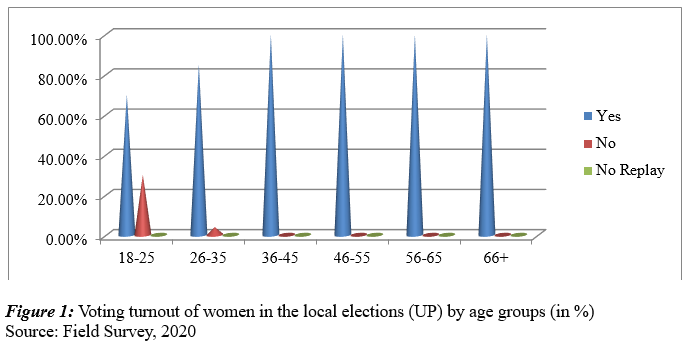
Figure 1 exemplifies that out of 181 women respondents, almost (87.85%) of respondents voted regularly in local elections. All (100%) 36-45, 46-55, 56-65, and 66+ age groups voted in the Union Parishad election. On the contrary, 8.29% and 3.87% of respondents belonging to the 18-25 and 26-35 age groups did not cast a vote in local elections. This statistic indicates that young and middle-aged women are more politically and socially active and concerned about their voting than older women. Thus, age is a crucial element for analyzing voter participation in local government elections, particularly UP elections. It reveals a positive correlation between age and women's participation in local elections.
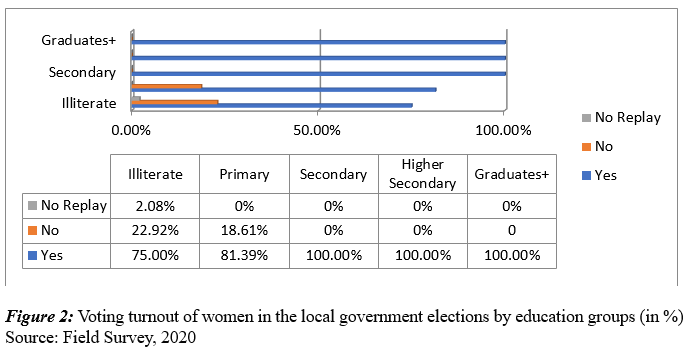
Another important variable for analyzing the voting turnout of rural women in UP elections is the rate of education. The data shows that 100% of respondents with secondary, higher secondary, and graduate education participated in UP elections, as shown in Figure 2. Figure 2 shows that the participation rate in the election is higher for women who have education, for example, at the primary stage. In illiterate women, 75% of respondents cast their vote, and 23% of respondents did not vote in the UP elections. Thus, it has been demonstrated that there is a favorable correlation between rural women's voting and their level of education.
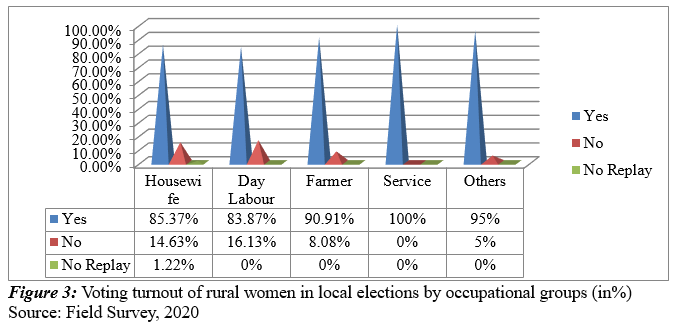
In analyzing the voting turnout of rural women in local elections, occupation can be considered the most crucial variable. Figure - 3 depicts that women in farming, service, and other occupational groups almost 100% voted in local elections. 11.3% and 12.5% of housewives and day laborers did not cast a vote in the local government elections.
Demographic Variables on Joining Electoral Meetings
In the electoral process, joining the electoral meeting is a pivotal mode of participation. This allows citizens to influence election results beyond their allotted one vote. Through electoral meetings, people are provided with electoral information and the manifestos of candidates. This study examines rural women's participation in local elections, particularly UP elections, by age, education, and occupation.
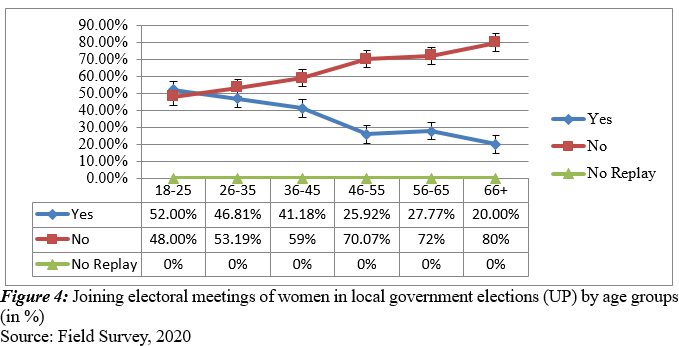
Figure 4 presents that among the respondents, 52% are joining electoral meetings. Approximately 52% of the respondents aged 18-25 years hold the maximum percentage. The respondents from the 26-35 and 36-45 age ranges participated at 44.3% and 41% respectively. It is noteworthy that the 66+ age group is less participative (20%) in the electoral meetings. This demonstrates that rural women of young and middle age are highly active and participate in these forms of electoral gatherings.
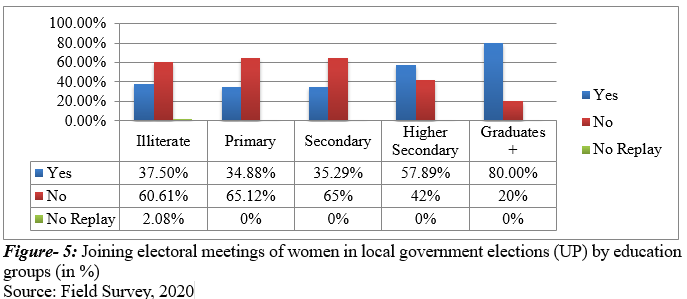
Figure 5 indicates a significant correlation between women's participation in local elections and their level of education. The figure shows that 31.2% of primary, 30.5% of secondary, 30.2% of higher secondary, and 85% of graduate respondents participated in electoral meetings in the local elections. Therefore, the more highly educated respondents are very active in electoral participation.
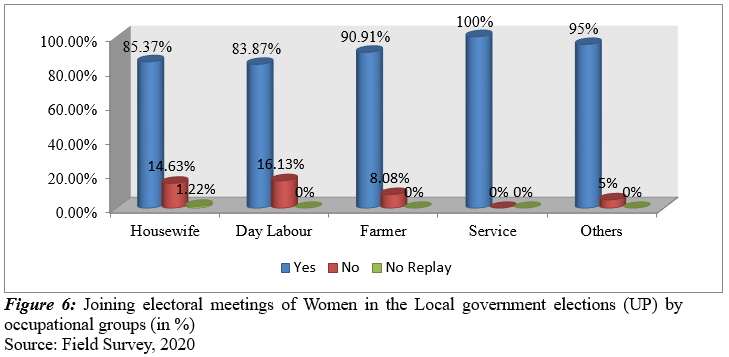
Figure 6 indicates that all professions in the research area have experienced a decline in voting participation. The majority of servicewomen, at 42.3%, participate in local government elections' electoral gatherings. In contrast, only 29.5% of housewives participate in election gatherings. Therefore, homemaker respondents show more interest in these forms of participation.
Joining Electoral Processions
The electoral procession is considered one of the key components of political participation. It is designed to focus participants' attention on a particular candidate. Those who are knowledgeable about political activities usually take part in such processions. Currently, we are aiming to evaluate the influence of rural women's age, education, and occupation on their participation in local government elections.
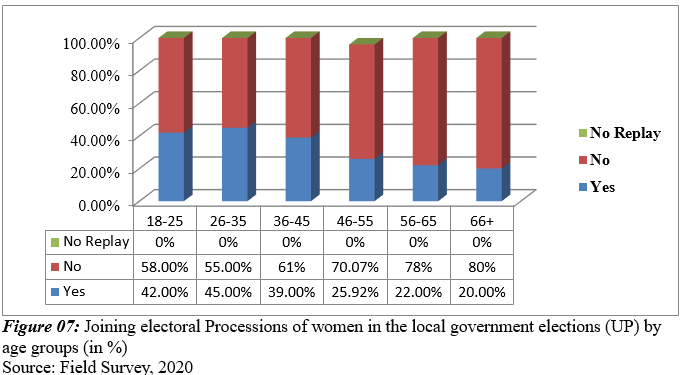
Figure 07 highlights that 43.2% of the women respondents are participating in electoral processions in the local elections. The highest percentage, 43.2%, belongs to the respondents in the 26-35 age group. Respondents aged 18-25 participate at a rate of 41.1% in the processions. Conversely, respondents in the age ranges of 36-45 and 66+ years participate less in the local government elections. This suggests that younger respondents are actively engaging in these types of electoral actions.
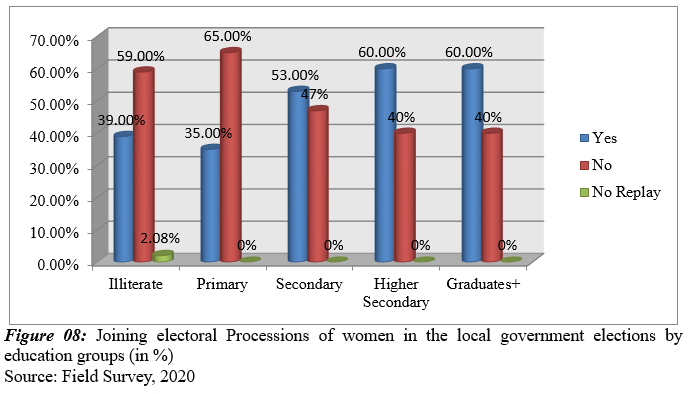
Education has always been considered a pivotal factor in determining voter participation in electoral processions. According to Figure 08, 57.8% of graduates, 55.4% of those with a higher secondary level of education, and 45.6% of those with a secondary level of education participate in electoral processions. The illiterate and primary education groups are represented at rates of 28% and 25.1%, respectively. Therefore, it is evident that respondents with a graduation or higher secondary education are actively engaging in electoral processions.
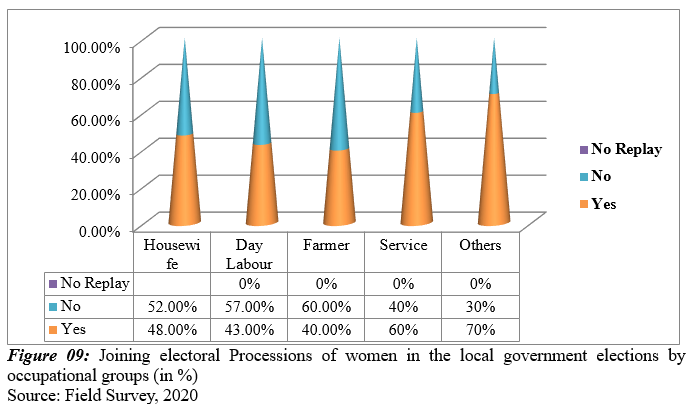
Occupation is a significant variable in interpreting the participation of respondents in electoral processions in Bangladesh. According to Figure 09, 43.1% of housewives, 40.9% of day laborers, farmers, and servicewomen each, participated in electoral processions during local government elections. Housewives and female farmers were identified as less participative in electoral processions.
Campaign Activities
Campaign activity is considered the heart of political culture, providing people with the opportunity to gather information about candidates and enabling candidates to make predictions about electoral results. There is no denying the fact that campaigning plays a crucial role in the election process. Similar to voting, it places significant pressure on candidates as it can reveal valuable information about the preferences of participants and requires cooperation among voters. By utilizing age, education, and occupation as independent demographic factors, we aim to assess the campaign performances of women in the UP elections.
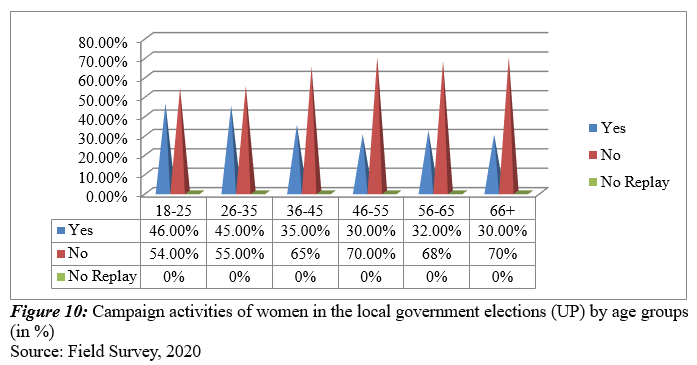
Figure 10 indicates that 43.2% of female respondents in the local region are actively involved in campaign activities. Specifically, nearly 43.2% of respondents in the 18-25 age group are participating in campaigning activities. Women in the 36-45 and 46-55 age groups are actively participating at rates of 28.45% and 27.5%, respectively. In contrast, respondents in the 66+ age group are less participative, with a rate of 24.5% in campaign activities. This suggests that respondents in the 18-25 age group are notably active in local government elections.
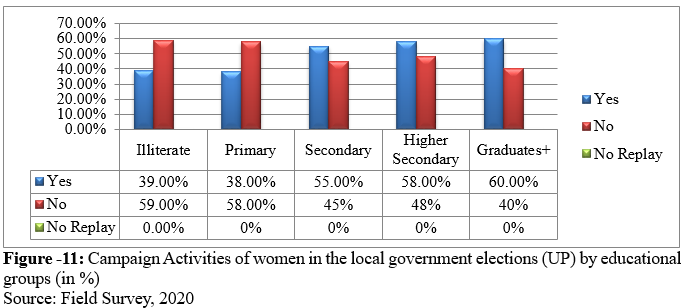
Education is considered one of the pivotal variables for interpreting women's participation in electoral campaign activities. According to Figure 11, respondents with secondary, higher secondary, and graduate degrees are participating in campaign programs at rates of 52.2%, 53.4%, and 54.8%, respectively. On the other hand, respondents with no institutional education background are rarely participating in campaign programs. Additionally, those with only a primary level educational qualification are less involved in campaigning activities during local government elections. This suggests that respondents from higher educated groups are more motivated to participate in campaign activities.
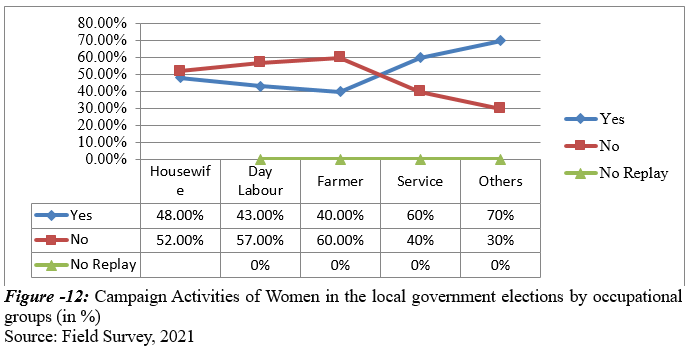
Figure 12 indicates that women from all professions participate in campaign activities, but their participation rates vary. The majority of service women (59.10%) and women in other professions (62.3%) are actively involved in campaign activities during local elections. However, only 40% of housewives participate in campaign activities. The reasons behind this lower participation among housewives could be attributed to the perception that campaign work is primarily for men, and they may prefer to focus on private spheres rather than public engagement.
Discussion
The findings presented shed light on the electoral participation of rural women in local government elections in Bangladesh, focusing on voting turnout, participation in electoral meetings, joining electoral processions, and engaging in campaign activities. These aspects are crucial for understanding the dynamics of women's involvement in the political process and their contribution to shaping governance at the grassroots level. It has been revealed that improved outcomes in local governance can enhance participation, cooperation, and civic engagement among residents. When local government bodies effectively deliver public services, engage with communities, and involve residents in decision-making processes, it can lead to increased trust, satisfaction, and active participation in local governance. Residents are more likely to contribute to community development initiatives, participate in civic activities, and collaborate with local authorities when they perceive positive outcomes and benefits from local governance efforts. Stronger local governance can foster a sense of ownership, responsibility, and belonging among residents, encouraging them to be more actively involved in shaping the future of their communities. Ultimately, improved outcomes in local governance contribute to building stronger, more resilient, and cohesive communities where residents are empowered to participate, cooperate, and engage in local decision-making processes.The high voting turnout among women in local elections, as evidenced by Figure 1, underscores their active engagement in the democratic process. It is noteworthy that age plays a significant role in determining voting behavior, with younger and middle-aged women exhibiting higher levels of participation compared to older counterparts. A recent study finds (Goerres, 2007) that older people more likely to vote. This finding suggests that efforts to encourage political awareness and civic engagement among elderly women could potentially increase overall electoral turnout and ensure broader representation in local governance structures. Furthermore, education emerges as a key determinant of voting behavior, with highly educated women exhibiting higher levels of electoral participation. This highlights the importance of educational empowerment in fostering political agency and enhancing women's contributions to democratic processes. However, the lower voting turnout among illiterate and primary-educated women underscores the need for targeted initiatives aimed at increasing political awareness and participation among marginalized segments of society. Occupational status also influences voting behavior, with women engaged in farming, service, and other occupations demonstrating high levels of electoral participation. In contrast, housewives and day laborers exhibit lower voting turnout rates, indicating potential barriers to political engagement within these occupational groups. Addressing these barriers through targeted outreach and empowerment initiatives could help promote greater inclusivity and representation in local governance.
The findings are similar to a study conducted by Coffé (2013) that reveal varying levels of participation among rural women in electoral meetings and processions, with age, education, and occupation playing significant roles. Younger and middle-aged women demonstrate higher levels of participation in these electoral activities, suggesting greater political awareness and activism among these demographic groups. Similarly, highly educated women exhibit higher rates of participation in electoral meetings and processions, highlighting the positive impact of educational empowerment on political engagement. Occupational status also influences participation in electoral activities, with service women demonstrating higher levels of engagement compared to housewives and farmers. This disparity underscores the need for targeted interventions to address barriers to political participation among women in traditionally marginalized occupational sectors.
The findings indicate varying levels of participation among rural women in campaign activities, with age, education, and occupation serving as significant determinants. Coffé & Bolzendahl (2010) find a similar finding in their study. Younger women and those with higher levels of education exhibit higher rates of participation in campaign activities, reflecting greater political awareness and activism among these demographic groups. Similarly, service women demonstrate higher levels of engagement in campaign activities compared to housewives, suggesting differential patterns of political participation across occupational sectors.
Conclusion and Recommendations
The main findings of this study highlight the multifaceted nature of women's electoral participation in local government elections in Bangladesh. While significant strides have been made in promoting political awareness and engagement among rural women, there remain challenges related to age, education, and occupational status that must be addressed to ensure broader representation and inclusivity in local governance. Targeted interventions aimed at enhancing political empowerment, educational opportunities, and economic empowerment among marginalized groups can play a pivotal role in fostering greater gender equality and democratic participation at the grassroots level. Finally, this study concludes that women are not apathetic in exercising their political rights, particularly in the local government elections and the rate of their electoral participation is gradually increasing at a good rate. Therefore, the study recommends that the government of Bangladesh should create more effective opportunities for enhancing the political participation of women, especially rural women, and remove all briars to compel women to remain inactive in political spheres.
References
Corresponding Author. E-mail: naimsiddique@pol.jnu.ac.bd